How to Disable Auto-Updates in WordPress

On this page
Want this handled for you?
Get startedHow do you disable auto-updates in WordPress?
Turn off WordPress auto-updates for core, plugins and themes in minutes, then set up the safer middle ground that keeps security fixes flowing to your site.
To disable WordPress auto-updates, switch them off where they live: the toggle under Dashboard → Updates for core, the “Disable auto-updates” links on the Plugins and Themes screens, or a constant in wp-config.php if you want everything off at once. Developers can go further with a few filters in a small must-use plugin. Each method takes minutes. The harder question is whether you should, and what you put in place instead, because an update you skip is a security fix you don’t get.
What WordPress updates on its own
WordPress checks for new versions about twice a day using its built-in scheduler, WP-Cron. When it finds one that it’s allowed to install, it downloads and installs it in the background, without anyone clicking a button. What it’s allowed to install depends on the type of update:
- Core minor releases, such as 6.6.1 to 6.6.2. These are maintenance and security releases, and they install automatically by default. This has been the case since WordPress 3.7.
- Core major releases, such as 6.6 to 6.7. Since WordPress 5.6 there’s a switch for these on the Updates screen. Depending on how and when your site was set up, and what your host configured, it may already be on.
- Plugins and themes. Since WordPress 5.5, each plugin and theme has its own auto-update setting. They’re off by default, but some hosts and managed platforms switch them on for you.
- Translations. Language packs for core, plugins and themes update automatically by default. They’re small and rarely cause trouble.
Unsure what your site does today? Open Tools → Site Health. The “Background updates” check tells you whether automatic updates can run, and the Updates screen tells you what WordPress will install on its own. That’s your starting point before you disable WordPress auto-updates of any kind.
The risks of leaving auto-updates on, and of turning them off
People usually want to disable WordPress auto-updates after a bad morning: a plugin updated overnight, the checkout stopped working, and nobody knew why until a customer complained. That’s a real risk. But switching updates off swaps one risk for another, so it helps to see both side by side.
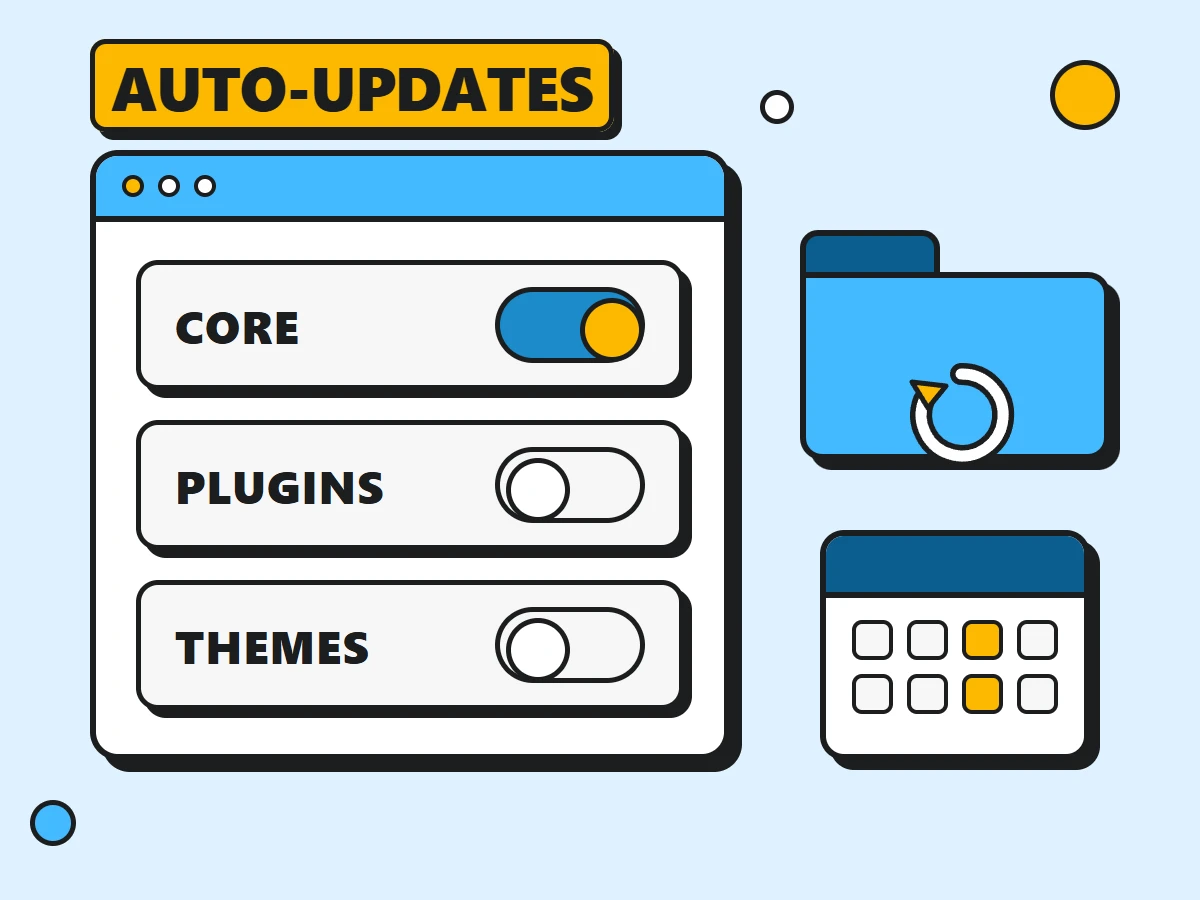
With auto-updates on, the main risk is an update that clashes with your setup. A plugin changes how it works, a theme overrides a template that changed, or two plugins stop getting along. Because it happens in the background, you may not notice until something visible breaks. Major core updates and big plugin releases carry the most risk; minor core releases rarely cause problems.
Recent versions of WordPress soften this a little. Since WordPress 6.6, if a plugin auto-update causes a fatal error, WordPress tries to roll the plugin back to the previous version. That helps with the worst crashes, but it can’t catch a broken layout, a payment form that quietly fails, or a change in how a plugin behaves.
With auto-updates off, the risk is that nothing gets updated at all. Updates fix security holes, and once a fix is public, attackers know exactly what to look for on sites that haven’t applied it. Outdated plugins are one of the most common ways into a WordPress site, as we cover in our WordPress security tricks. Turning updates off only makes sense if someone is going to apply them by hand, on a schedule.
| Setting | Main benefit | Main risk | Effort |
|---|---|---|---|
| Everything on | Security fixes arrive within hours | An update breaks something while nobody is watching | Low |
| Core minor only (the default) | Security releases install, big changes wait | Plugins and themes fall behind unless you update them | Ongoing |
| Everything off | Nothing changes without your say-so | Known security holes stay open until you act | High |
| Off, with scheduled manual updates | Control plus testing before changes go live | Only works if the schedule is kept | Ongoing |
Turn off core auto-updates from Dashboard → Updates
The quickest way to disable WordPress auto-updates for major core releases needs no code. Log in as an administrator and go to Dashboard → Updates. Near the top you’ll see a line about automatic updates:
- If it says the site is set to update automatically to all new versions of WordPress, click Switch to automatic updates for maintenance and security releases only. Major releases now wait for you; minor security releases still install.
- If it says the site updates for maintenance and security releases only, you’re already on the default. The link offered there switches major updates on.
Note what this screen can’t do: it has no option to turn off minor core updates. That’s deliberate, because minor releases are where security fixes land. If you really want to stop them too, use a constant (method 3) or a filter (method 4).
If the options are missing and the screen simply states how updates are set, a constant or filter is already in control, usually added by your host or a developer. Change it where it was set, not here.
Disable auto-updates for plugins and themes
Plugins and themes each have their own switch, so you can disable WordPress auto-updates for one risky plugin and leave the rest alone.
Plugins
- Go to Plugins → Installed Plugins.
- Find the Automatic Updates column on the right.
- Click Disable auto-updates next to each plugin you want to update by hand. Click Enable auto-updates to switch it back on.
To change many at once, tick the plugins, pick Disable Auto-updates from the Bulk actions menu, and click Apply.
Themes
- Go to Appearance → Themes.
- Click a theme to open its details.
- Click Disable auto-updates under the theme’s description.
Don’t forget the parent theme if you use a child theme. The child rarely gets updates; the parent does, and that’s the one that can change your layout.
A word on premium plugins and themes: if they update through their own licence system, the toggle may have no effect until the developer’s update code supports it. Check their settings page as well.
Disable WordPress auto-updates with wp-config.php constants
If you want a setting that no admin user can change from the dashboard, use constants in wp-config.php. This file sits in the root of your WordPress install. Edit it over SFTP or your host’s file manager, take a copy first, and add your lines above the line that says /* That’s all, stop editing! Happy publishing. */.
Turn off all automatic updates
This one line is the fastest way to disable WordPress auto-updates completely: core, plugins, themes and translations all stop updating in the background.
define( 'AUTOMATIC_UPDATER_DISABLED', true );It’s the bluntest tool, and it’s the one to be most careful with. Once it’s in place, security releases won’t install themselves either, so someone has to update the site by hand. Manual updates from Dashboard → Updates still work as normal.
Control core updates only
WP_AUTO_UPDATE_CORE decides which core releases install automatically. It doesn’t touch plugins or themes.
// No automatic core updates at all.
define( 'WP_AUTO_UPDATE_CORE', false );

// Minor (maintenance and security) releases only. This is the default.
define( 'WP_AUTO_UPDATE_CORE', 'minor' );

// All core releases, including major versions.
define( 'WP_AUTO_UPDATE_CORE', true );
Use one of these lines, not all three. For most sites, 'minor' is the right choice: it’s the same as the default, but written down, so a later change of host or plugin can’t quietly switch major updates on. Once the constant is set, the auto-update switch on the Updates screen follows it and can’t be changed from the dashboard.
There’s also DISALLOW_FILE_MODS. Set to true, it blocks installing, updating and editing plugins and themes from the dashboard, and that includes automatic updates. It suits sites that are deployed from version control, but on a normal site it stops you updating anything from wp-admin, so don’t add it just to stop auto-updates.
The official guide to configuring automatic background updates lists these constants and the filters below, and the wp-config.php reference explains where everything goes in the file.
Fine-tune auto-updates with filters in a mu-plugin
Constants are all-or-nothing. Filters let you disable WordPress auto-updates selectively: keep security releases, block major ones, and leave auto-updates on for every plugin except the two that broke your shop last time. The best home for them is a must-use plugin (mu-plugin). WordPress loads every PHP file in wp-content/mu-plugins/ automatically, it can’t be switched off from the Plugins screen, and it keeps working when you change theme. A theme’s functions.php is a poor place for this code, because a theme switch wipes out your rules.
Create the folder wp-content/mu-plugins/ if it doesn’t exist, then add a file such as update-rules.php:
<?php
/**
 * Plugin Name: Update rules
 * Description: Controls which WordPress auto-updates may run.
 */

// Core: keep minor (security) releases, block major ones.
add_filter( 'allow_minor_auto_core_updates', '__return_true' );
add_filter( 'allow_major_auto_core_updates', '__return_false' );

// Plugins: auto-update everything except the plugins listed here.
add_filter( 'auto_update_plugin', function ( $update, $item ) {
	$manual_only = array(
		'woocommerce/woocommerce.php',
		'my-page-builder/my-page-builder.php',
	);
	if ( isset( $item->plugin ) && in_array( $item->plugin, $manual_only, true ) ) {
		return false;
	}
	return $update;
}, 10, 2 );

// Themes: no automatic theme updates.
add_filter( 'auto_update_theme', '__return_false' );
Replace the two example paths with your own. The value is the plugin’s folder and main file, which you can see in the plugin’s folder under wp-content/plugins/. Returning $update at the end keeps the choice you made with the toggles for every plugin you didn’t list.
The filters you’ll use most:
auto_update_core: returnfalseto block every automatic core update, minor ones included.allow_major_auto_core_updatesandallow_minor_auto_core_updates: allow or block each type of core release.auto_update_pluginandauto_update_theme: decide per item, as in the example. Returnfalsefrom a one-liner to block them all.auto_update_translation: returnfalseto stop automatic language pack updates.automatic_updater_disabled: returntrueto turn the whole updater off, like the constant.
A filter overrides the toggles on the Plugins and Themes screens, so the dashboard may no longer match what you click. The auto_update_plugin reference shows the full details of the $item object if you want to match on something else.
Keep the update emails too. WordPress emails the site’s admin address after background updates, and those emails are often the first sign something changed. If they’re too noisy, the auto_plugin_update_send_email and auto_theme_update_send_email filters can turn them off, but think twice: an update you don’t hear about is harder to trace when something breaks.
A safer middle ground: controlled, scheduled updates
For most business sites, the best setup isn’t “all on” or “all off”. It’s updates that still happen, but under control. Here’s a routine that works:
- Let minor core releases install automatically. They’re small, they’re tested hard, and they carry security fixes. Leave
WP_AUTO_UPDATE_COREat'minor'. - Pick your risky plugins. WooCommerce, page builders, payment gateways, membership plugins and anything heavily customised update by hand. Small, simple plugins can stay on auto-update.
- Back up first, every time. Files and database, stored off the server. If an update goes wrong, a restore takes minutes instead of a day of repairs.
- Test on a staging copy. Apply the update to a copy of the site, click through the pages that matter (forms, checkout, logins) and only then update the live site. Many hosts offer one-click staging; you can also clone your WordPress site yourself.
- Update on a fixed day. Once a week suits most sites. Pick a quiet time, not a Friday evening, and check the site afterwards.
- Apply security fixes straight away. If a plugin release fixes a vulnerability, don’t wait for the weekly slot.
This keeps the benefit you wanted when you set out to disable WordPress auto-updates (no surprise changes) without the cost of a site that slowly falls behind. The catch is that the routine only works if someone actually keeps it. That’s the part most small businesses struggle with, and it’s what a WordPress maintenance service is for.
The bottom line
You can disable WordPress auto-updates in minutes: the Updates screen for major core releases, the per-item links for plugins and themes, wp-config.php constants for a hard rule, and filters in a mu-plugin for precise control. Turning them off is the easy part. Before you do, decide who will run updates instead, how often, and how you’ll recover if one goes wrong. Keep minor core updates on, back up before every change, test the big ones on staging, and never leave a security fix waiting.
Frequently asked questions
It’s safe only if you replace them with regular manual updates. Turning them off and forgetting about them leaves known security holes open. A good compromise is to keep minor core updates on and update plugins and themes by hand once a week.
No. It only stops background updates. You can still update core, plugins and themes from Dashboard → Updates or the Plugins screen. To block dashboard updates as well, you’d need DISALLOW_FILE_MODS, which also blocks installing plugins.
Something else is probably in control: a filter in a plugin or mu-plugin, a setting added by your host, or a premium plugin with its own updater. Check wp-content/mu-plugins/, your host’s dashboard and the plugin’s own settings.
Yes. Click Disable auto-updates next to that plugin on the Plugins screen, or use the auto_update_plugin filter to return false for that plugin’s file, as in the mu-plugin example above.
Usually not. Language packs are small and rarely break anything. Turn them off with the auto_update_translation filter only if you maintain custom translations that an update would overwrite.
Yes. Every Jompom plan includes core, plugin and theme updates done with cloud backups in place, plus uptime monitoring and security scans. A WordPress expert fixes anything an update breaks, and you get a report for every task. See the plans.